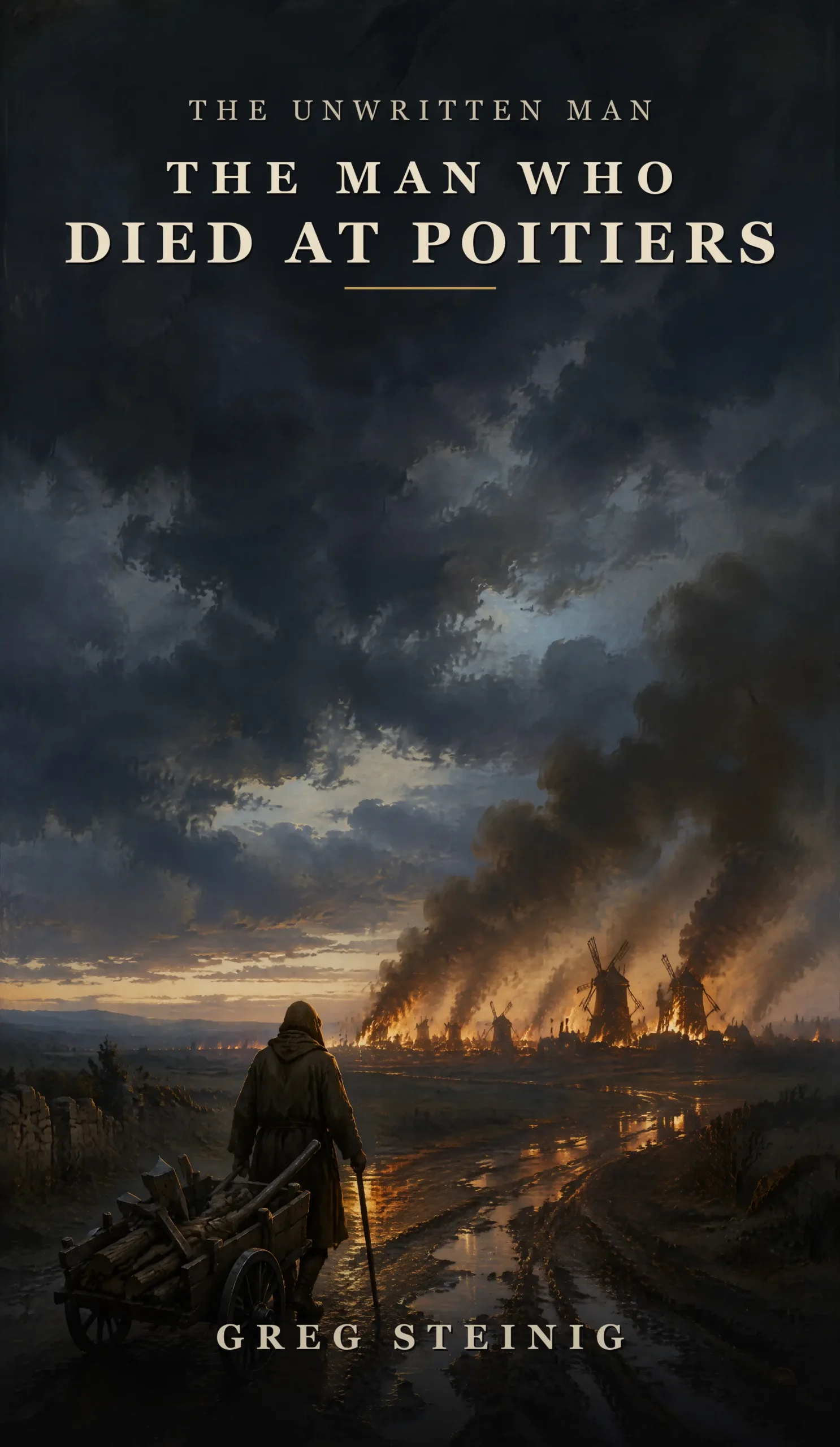
He cannot stay dead.
In this army, that is the thing most likely to get him killed.
Gascony, 1355. The Black Prince is burning a road to Poitiers, and the man who builds his siege engines has a wound that closed overnight.
The Man Who Died at Poitiers
In the summer of 1355 the Prince of Wales rode out of Bordeaux with somewhere between 5,000 and 8,000 men and orders to ruin everything between the sea and Toulouse. Towns that paid were spared. Towns that did not were burned to the sills.
Somewhere in the baggage train is a pressed engineer who can tell you how many fascines it takes to cross a marsh, how long a wall stands under a trebuchet, and what a man costs to feed on the march. He is very good at his work. He has had a long time to learn it.
He is also careful, in the way of a man with something to hide, because a wound that closes overnight is not a miracle in this century. It is evidence. And the men who find evidence build a fire around it.
More about the bookCampaign Papers
You have downloaded a sample from an unknown writer before. It went badly, three paragraphs in, and you went back to something you trusted.
So here is the prologue and the first three chapters. Not a teaser, not a page and a half of front matter. The whole opening of the book, laid out properly, free.
Read them and decide. That is the entire pitch.
Greg Steinig
I wrote it because I wanted to read it and could not find it. I chose this war because it is the rare campaign where the strategy and the crime are the same act, and nobody inside it could pretend otherwise.
Before this I spent twenty years in technology sales, and ran sales for a company as it went from $20 million to $100 million. That is not a writing credential and I am not going to dress it up as one. What it left me was a method.
About